NEW YORK, USA, June 18, 2026 (GLOBE NEWSWIRE) -- Zion Market Research has published a new research report titled “Healthcare Command Centers Market By Type (Operational Command Centers, Emergency & Disaster Response Command Centers, Patient Flow Command Centers, Clinical Command Centers and Integrated/Enterprise-Wide Command Centers), By Component (Software, Hardware and Services), By Application (Patient Flow & Capacity Management, Emergency Response & Crisis Management, Bed Management, Staff Allocation & Scheduling, Telehealth & Remote Care Coordination and Real-Time Decision Support), By End User (Hospitals, Specialty Clinics, Ambulatory Surgical Centers, Multi-Hospital Health Systems and Government & Military Health Facilities), By Deployment Mode (On-Premise, Hybrid and Cloud-Based) and By Region - Global and Regional Industry Overview, Market Intelligence, Comprehensive Analysis, Historical Data, and Forecasts 2025 - 2034” in its research database.
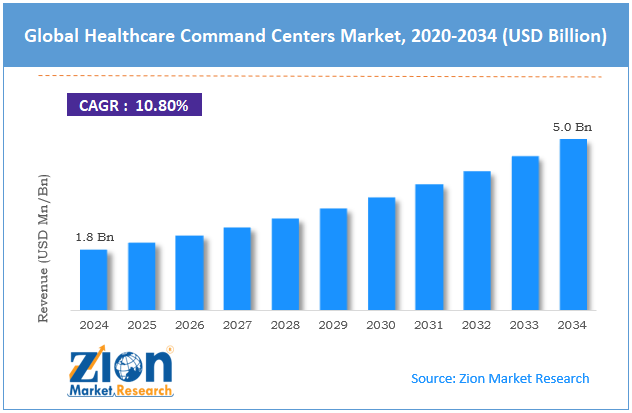
“According to the latest research study, the global healthcare command centers market size was valued at around USD 1.8 billion in 2024. The market is expected to grow at a CAGR of 10.8% and is anticipated to reach a value of USD 5.0 billion by 2034.”
Get a Free Sample PDF of this Research Report for more Insights - https://www.zionmarketresearch.com/sample/healthcare-command-centers-market
(Before you plan to buy, sample reports are a great option to examine our in-depth studies or reports)
Healthcare Command Centers Market Overview:
Healthcare command centers are centralized operating units that use information gathered from multiple platforms to monitor the clinical, administrative, and logistical aspects of healthcare facility operations. They provide a comprehensive view of all patient care activities through advanced technologies such as artificial intelligence, predictive analytics, machine learning, Internet of Things devices, and electronic health records. These centers enable real-time oversight of patient flow, bed occupancy, workforce staffing, equipment usage, and emergency activities, empowering facility managers to make informed, data-driven decisions.
Demand for healthcare command centers is projected to grow due to the rising need for efficient patient flow management and operational optimization in healthcare facilities during the forecast period, increasing patient volumes, staffing shortages, and the push for digital transformation further support market expansion. However, high implementation costs, infrastructure challenges, and limited adoption in developing regions may restrain growth.
Report Scope:
| Report Attribute | Report Details |
| Market Size in 2024 | USD 1.8 Billion |
| Market Forecast in 2034 | USD 5.0 Billion |
| Growth Rate | CAGR of 10.8% |
| Base Year | 2024 |
| Forecast Years | 2025- 2034 |
| Key Companies Covered | GE HealthCare, ABOUT Healthcare Inc., Koninklijke Philips N.V., TeleTracking Technologies Inc., Siemens Healthineers, Qventus, Oracle (Cerner), Epic Systems, LeanTaaS, Dedalus, care.ai, Care Logistics, Constant Technologies Inc, L&T Technology Services Limited, Leidos, Systematic Healthcare, ASCEND Solutions, and others. |
| Segments Covered | By Type, By Component, By Application, By End User, By Deployment Mode, and By Region |
| Regions Covered | North America, Europe, Asia Pacific, Latin America, and the Middle East & Africa |
| Customization Scope | Avail customized purchase options to meet your exact research needs. |
Directly Purchase a Copy of the Report | Quick Delivery Available - https://www.zionmarketresearch.com/buynow/su/healthcare-command-centers-market
Key Insights from Primary Research
- As per the analysis, the healthcare command centers market share is likely to grow at a CAGR of around 10.8% between 2025 and 2034.
- The healthcare command centers market size was worth around $1.8 billion in 2024 and is estimated to hit approximately $5.0 billion by 2034. Due to a variety of driving factors, the market is predicted to rise at a significant rate.
- The healthcare command centers market is driven by the growing digital transformation of hospitals.
- Based on the type, the patient flow command centers segment dominated and is expected to drive strong revenue due to its critical role in managing admissions, discharges, and bed occupancy.
- Based on the component, the software segment dominated with 48% share owing to its essential role in data integration, analytics, and real-time decision support.
- Based on the application, the patient flow & capacity management segment captured the largest market share, driven by the need to reduce overcrowding and optimize resources.
- Based on the end user, the hospital segment dominated the market due to high operational complexity and patient volume.
- Based on the deployment mode, the cloud-based segment dominated with 49% share in 2024 due to scalability and cost-effectiveness.
- Based on region, North America dominated the global market with 41% share, driven by advanced healthcare infrastructure and technology adoption.
Healthcare Command Centers Market: Dynamics
Growth Drivers
Why does the rising need for efficient patient flow management drive the healthcare command centers market?
The global healthcare command centers market is expected to be driven by the rising need for efficient patient flow management in healthcare facilities. Hospitals face challenges such as increased patient volumes, limited bed capacity, staffing shortages, and operational inefficiencies, leading to emergency department congestion and delayed care. Healthcare command centers address these issues by providing real-time visibility into patient admissions, transfers, discharges, and resource utilization.
Integration with electronic health records, bed management systems, and clinical workflows allows identification of bottlenecks and prediction of demand. This results in reduced wait times, faster bed turnover, improved care delivery, and enhanced patient experience while optimizing costs and staff productivity.
Restraints
How do high initial implementation and infrastructure costs hamper the growth of the healthcare command centers industry?
The global healthcare command centers industry is expected to be restricted due to high initial implementation and infrastructure costs. Setting up these centers requires significant investment in advanced software, AI technologies, data integration, hardware, cybersecurity, and staff training. Many healthcare institutions, particularly in resource-constrained settings, face budget limitations that delay adoption.
Additional expenses related to customization, maintenance, and legacy system integration further increase the financial burden, making it challenging for smaller facilities or developing regions to implement comprehensive command center solutions.
Opportunities
Why does the growing product launch offer a lucrative opportunity for the healthcare command centers market?
The global healthcare command centers market is anticipated to generate growth opportunities through growing product launches and innovations. For instance, new AI-enabled platforms accelerate deployment and integrate advanced healthcare technologies, supporting faster modernization and responsible AI adoption.
Expansion in emerging technologies and hybrid models presents new possibilities
Advancements in cloud computing, IoT integration, and hybrid deployment models offer opportunities for scalable solutions that cater to diverse healthcare settings. These innovations enable better interoperability and real-time coordination, particularly beneficial for multi-hospital systems and government facilities.
Challenges
Why does the limited adoption in developing regions pose a significant challenge to the healthcare command centers market?
The global healthcare command centers industry is expected to be challenged by limited adoption in developing regions. Many providers face budget constraints, inadequate digital infrastructure, and a lack of high-speed connectivity essential for advanced command centers.
Shortages of skilled personnel trained in healthcare informatics and analytics, along with prioritization of basic care over operational tools, further slow implementation. Addressing these gaps requires targeted strategies for technology accessibility and training.
Browse the full “Healthcare Command Centers Market By Type (Operational Command Centers, Emergency & Disaster Response Command Centers, Patient Flow Command Centers, Clinical Command Centers and Integrated/Enterprise-Wide Command Centers), By Component (Software, Hardware and Services), By Application (Patient Flow & Capacity Management, Emergency Response & Crisis Management, Bed Management, Staff Allocation & Scheduling, Telehealth & Remote Care Coordination and Real-Time Decision Support), By End User (Hospitals, Specialty Clinics, Ambulatory Surgical Centers, Multi-Hospital Health Systems and Government & Military Health Facilities), By Deployment Mode (On-Premise, Hybrid and Cloud-Based) and By Region - Global and Regional Industry Overview, Market Intelligence, Comprehensive Analysis, Historical Data, and Forecasts 2025 - 2034” Report at https://www.zionmarketresearch.com/report/healthcare-command-centers-market
Healthcare Command Centers Market: Segmentation
The healthcare command centers market is segmented by type, component, application, end user, deployment mode, and region.
Based on Type, the healthcare command centers market is divided into operational command centers, emergency & disaster response command centers, patient flow command centers, clinical command centers, integrated/enterprise-wide command centers, and others. The patient flow command centers segment was the most dominant, driving strong revenue due to the growing need to manage patient admissions, transfers, discharges, bed occupancy, and operational bottlenecks amid rising patient volumes and staffing shortages. This segment drives the market by enabling real-time monitoring, AI-driven predictions, and improved hospital efficiency, resulting in reduced wait times and higher bed turnover. The integrated/enterprise-wide command centers serve as the strong second most dominant, supporting centralized oversight across large health systems for comprehensive operational coordination.
Based on Component, the healthcare command centers market is divided into software, hardware, and services. The software segment was the most dominant with 48% share in 2024, as it forms the core of data analytics, integration, predictive modeling, and real-time decision-making capabilities. Software solutions help drive the market by enabling seamless connectivity with existing hospital systems and delivering actionable insights that optimize operations. The services segment holds the second position, providing essential implementation, training, maintenance, and consulting support that ensures successful deployment and long-term functionality.
Based on Application, the healthcare command centers market is divided into patient flow & capacity management, emergency response & crisis management, bed management, staff allocation & scheduling, telehealth & remote care coordination, real-time decision support, and others. The patient flow & capacity management segment dominated with the largest share, addressing critical issues like ER overcrowding, delayed discharges, and resource optimization. It drives the market by improving throughput, reducing costs, and enhancing patient outcomes through data-driven coordination. The emergency response & crisis management segment is the second most dominant, gaining importance for handling surges and disasters with real-time coordination.
Based on End User, the healthcare command centers market is divided into hospitals, specialty clinics, ambulatory surgical centers, multi-hospital health systems, government & military health facilities, and others. The hospitals segment was the most dominant due to high patient volumes, operational complexity, and the need for centralized management of resources and workflows. Hospitals drive the market by leveraging command centers to improve efficiency, reduce costs, and deliver better care. The multi-hospital health systems segment is the second most dominant, benefiting from enterprise-wide visibility and standardization across facilities.
Based on Deployment Mode, the healthcare command centers market is divided into on-premise, hybrid, and cloud-based. The cloud-based segment dominated with 49% share in 2024, favored for its scalability, flexibility, cost-effectiveness, and ease of integration with modern digital health tools. It drives the market by enabling remote access and rapid updates without heavy upfront infrastructure investment. The hybrid segment holds the second position, offering a balanced approach for organizations requiring both security and cloud advantages.
Regional Scope:
Why will North America continue to dominate the global market during the projection period?
The global healthcare command centers market is expected to be led by North America during the forecast period. The region benefits from a highly developed healthcare infrastructure, widespread adoption of digital health technologies, and a strong focus on operational efficiency. The United States and Canada lead with advanced implementation of EHRs, AI, predictive analytics, and IoT solutions that create an ideal environment for command centers. Healthcare providers address challenges such as high patient volumes and rising costs through these centralized systems.
Europe maintains significant growth supported by countries like Germany, the UK, and France, emphasizing smart hospital initiatives and regulatory support for digital transformation.
Asia Pacific is poised for rapid expansion driven by improving healthcare infrastructure, rising investments in technology, and increasing patient demands in countries such as China, India, and Japan. Latin America and the Middle East & Africa are expected to witness steady progress as governments and providers focus on modernizing facilities and enhancing emergency preparedness.
Request For Customization on This Report as Per Your Requirements - https://www.zionmarketresearch.com/custom/10633
Healthcare Command Centers Market: Competitive Landscape
The report contains qualitative and quantitative research on the global healthcare command centers market, as well as detailed insights and development strategies employed by the leading competitors.
Some of the main players in the global healthcare command centers market include;
- GE HealthCare
- ABOUT Healthcare Inc.
- Koninklijke Philips N.V.
- TeleTracking Technologies Inc.
- Siemens Healthineers
- Qventus
- Oracle (Cerner)
- Epic Systems
- LeanTaaS
- Dedalus
- care.ai
- Care Logistics
- Constant Technologies Inc
- L&T Technology Services Limited
- Leidos
- Systematic Healthcare
- ASCEND Solutions
The global healthcare command centers market is segmented as follows:
By Type
- Operational Command Centers
- Emergency & Disaster Response Command Centers
- Patient Flow Command Centers
- Clinical Command Centers
- Integrated/Enterprise-Wide Command Centers
By Component
- Software
- Hardware
- Services
By Application
- Patient Flow & Capacity Management
- Emergency Response & Crisis Management
- Bed Management
- Staff Allocation & Scheduling
- Telehealth & Remote Care Coordination
- Real-Time Decision Support
By End User
- Hospitals
- Specialty Clinics
- Ambulatory Surgical Centers
- Multi-Hospital Health Systems
- Government & Military Health Facilities
By Deployment Mode
- On-Premise
- Hybrid
- Cloud-Based
By Region
- North America
- The U.S.
- Canada
- Europe
- France
- The UK
- Spain
- Germany
- Italy
- Rest of Europe
- Asia Pacific
- China
- Japan
- India
- Southeast Asia
- Rest of Southeast Asia
- The Middle East & Africa
- GCC
- South Africa
- Rest of the Middle East & Africa
- Latin America
- Brazil
- Argentina
- Rest of Latin America
Request Free Brochure of the Global Healthcare Command Centers Market @ https://www.zionmarketresearch.com/requestbrochure/healthcare-command-centers-market
Key Questions Answered in This Report:
- What are healthcare command centers?
- What are the key growth drivers for the healthcare command centers market?
- What are the major challenges restraining the growth of the healthcare command centers market?
- Which segment is expected to dominate the healthcare command centers market?
- What are the emerging trends and innovations impacting the healthcare command centers market?
- What will be the value of the healthcare command centers market during 2025-2034?
- What will be the CAGR value of the healthcare command centers market during 2024-2032?
- Which region will contribute notably towards the healthcare command centers market value?
- Which are the major players leveraging the healthcare command centers market growth?
- What can be expected from the global healthcare command centers market report?
Recent Developments:
- In April 2026, ANSR introduced its new Healthcare GCC Accelerator Platform in collaboration with Optum to enable faster deployment of AI-enabled global capability centers for healthcare operations modernization.
Recent Market Trends:
Integration of AI and predictive analytics
The healthcare command centers industry is witnessing strong integration of artificial intelligence and predictive analytics. These technologies enhance real-time decision support, forecast patient demand, and optimize resource allocation across facilities.
Adoption of cloud-based and hybrid solutions
There is a clear shift toward cloud-based and hybrid deployment models that provide greater flexibility, scalability, and cost efficiency while supporting seamless data interoperability and remote monitoring capabilities.
Browse Other Related Research Reports
- Cupping Devices Market By Product Type (Manual Cupping Devices, Electrical Cupping Devices, Mechanical Cupping Devices, Silicone Cupping Devices, and Others), By Application (Pain Management, Respiratory Issues, Skin Care, Digestive Disorders, and Others), By End-User (Hospitals, Clinics, Spas and Wellness Centers, and Home Use), and By Region - Global and Regional Industry Overview, Market Intelligence, Comprehensive Analysis, Historical Data, and Forecasts 2025 - 2034
- Acute Care Providers Market By Facility (General Acute Care Hospitals, Psychiatric Hospitals, Specialized Hospitals, Rehabilitation Hospitals, and Long-Term Acute Care Units), By Medical Condition (Emergency Care, Trauma Care, Acute Care Surgery, Short-term Stabilization, and Others), By Service Type (Intensive Care Unit (ICU), Coronary Care Unit (CCU), Neonatal Intensive Care Unit (NICU), Emergency Room/Urgent Care Services, and Others), By Delivery Mode (Inpatient Acute Care, Outpatient Emergency/Urgent Care, Telehealth/Virtual Acute Care Services and Ambulatory Surgery Centers (ASC)), and By Region - Global and Regional Industry Overview, Market Intelligence, Comprehensive Analysis, Historical Data, and Forecasts 2025 - 2034
- Air Ambulance Services Market By Service Type (Medical Evacuation, Medical Repatriation, Organ Transport, Neonatal and Pediatric Transport, Disaster Response, and Others), By Aircraft Type (Helicopters, Fixed-Wing Aircraft), By End-User (Hospitals, Insurance Companies, Governments, Private Individuals, Military), By Application (Emergency Medical Services, Patient Transfer, Specialty Care Transport, Disaster Relief), and By Region - Global and Regional Industry Overview, Market Intelligence, Comprehensive Analysis, Historical Data, and Forecasts 2025 - 2034
- Ligating Clips Market By Type (Polymer Ligating Clips, Hemostatic Ligating Clips, Metal Ligating Clips, and Others), By Application (Surgery, Vascular Ligations, Endoscopy, and Others), By End-User (Hospitals and Clinics, Research Institutes, Ambulatory Surgical Centers, and Others), and By Region - Global and Regional Industry Overview, Market Intelligence, Comprehensive Analysis, Historical Data, and Forecasts 2025 - 2034
- Antiemetics Market By Indication (Motion Sickness, Chemotherapy-Induced Nausea, Pregnancy-related Nausea, Postoperative Nausea & Vomiting, and Radiation-Infused Nausea), By Route of Administration (Rectal, Transdermal, Oral, Intravenous, and Subcutaneous), and By Region - Global and Regional Industry Overview, Market Intelligence, Comprehensive Analysis, Historical Data, and Forecasts 2025 - 2034
- Pitavastatin Market By Type (1mg, 2mg, and 5mg), By Product (Capsules, Tablets, and Oral Solutions), By Application (Cardiovascular Disease Prevention and Hyperlipidemia), By Sales Channel (Online Pharmacies, Retail Pharmacies, Clinics, and Hospitals), and By Region - Global and Regional Industry Overview, Market Intelligence, Comprehensive Analysis, Historical Data, and Forecasts 2025 - 2034
- Disposable Protective Clothing Market By Material (Polyethylene, Polypropylene, Polyester, and Others), By Application (Thermal, Chemical, Mechanical, Biological/Radiation, Visibility, and Others), By End-Use Industry (Oil & Gas, Construction, Manufacturing, Healthcare/Medical, Mining, Defense & Public Safety, and Others), and By Region - Global and Regional Industry Overview, Market Intelligence, Comprehensive Analysis, Historical Data, and Forecasts 2025 - 2034
- Outpatient Care Market By Service Type (Ambulatory Surgical Centers (ASCs), Diagnostic Imaging Centers, Specialty Clinics, Urgent Care Centers, Family Planning Centers, Outpatient Mental Health, Primary Care Clinics, and Others), By Application (Hospitals, Ambulatory Surgical Centers, and Others), By Expenditure Type (Public and Private), and By Region - Global and Regional Industry Overview, Market Intelligence, Comprehensive Analysis, Historical Data, and Forecasts 2025 - 2034
About Zion Market Research:
Zion Market Research is a leading market research organization offering industry expertise and scrupulous consulting services to clients for their business development. The reports and services offered by Zion Market Research are used by prestigious academic institutions, start-ups, and companies globally to measure and understand the changing international and regional business backgrounds.
Contact Us:
Zion Market Research
USA/Canada Toll Free: 1 (855) 465-4651 | Newark: 1 (302) 444-0166
India: +91 7768 006 007 | +91 7768 006 008
Email: sales@zionmarketresearch.com | Web: https://www.zionmarketresearch.com/
Follow Us on - LinkedIn | X | Facebook | Pinterest | YouTube